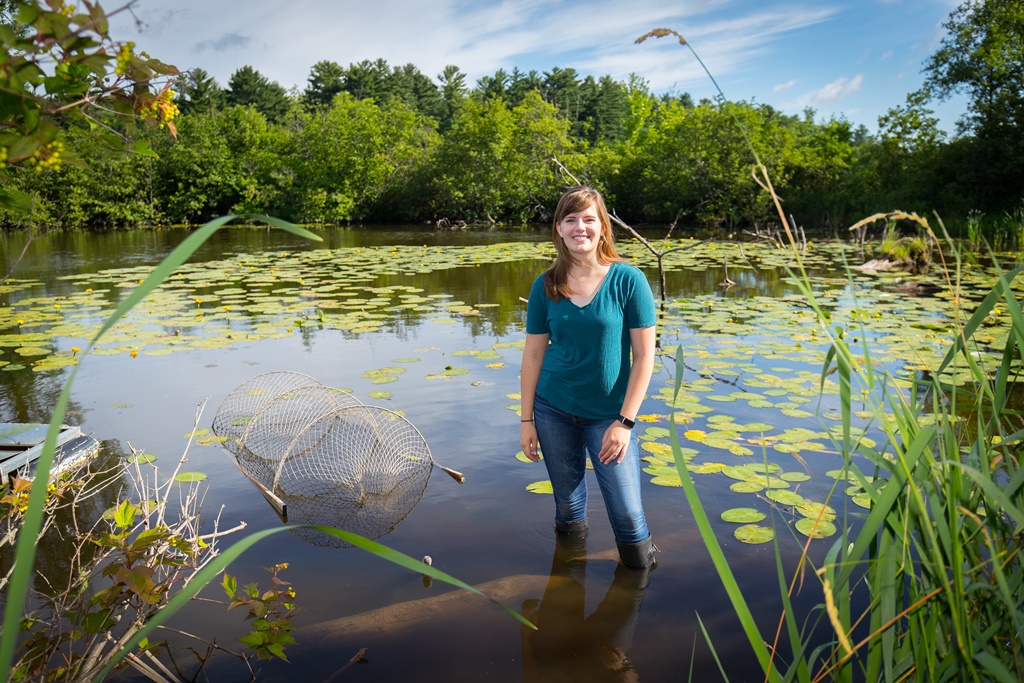
 Mara Hathaway
One day when she was 7, Mara Hathaway, dressed in a blue raincoat, was hiking at a Minnesota state park when she picked up a frog and her mom took her picture. For many, this might not represent a significant day. Yet for Mara, it was the day she discovered she loves learning about animals.
That love of animals has followed Mara from St. Louis Park, Minn., to the University of Wisconsin-Stevens Point, where the second-year student majors in
biology, minors in
chemistry, dreams of working in
veterinary science and serves as a turtle wrangler.
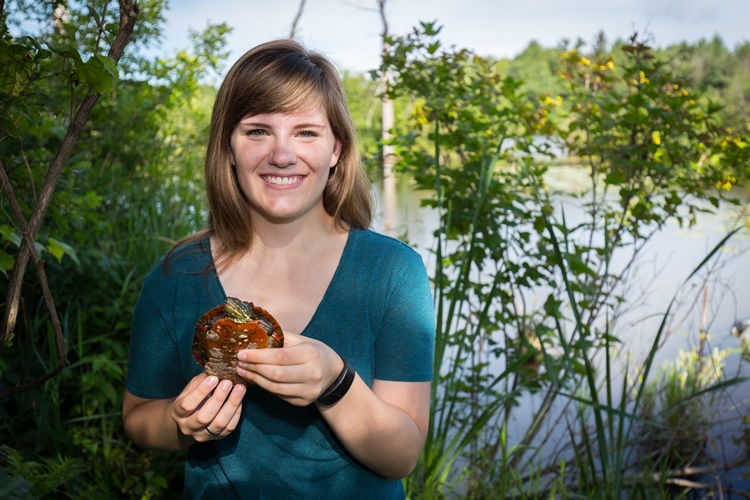
UW-Stevens Point is “a big enough campus that you get amazing opportunities like being a turtle wrangler,” she said. “But it’s still small enough that you have connections with your professors. No matter where you are on campus you find someone you recognize. After I looked over all the courses I’d be taking, I went on a visit and it felt like home.”
If the question is, “Why did the turtle cross the road?” the answer is “to lay eggs” and the turtle wranglers help them do that. Mara, as one of five student turtle wranglers, has worked with
biology lecturer Nancy Shefferly since April to keep the turtles safe along a stretch of Highway 66 near Jordan Park in Stevens Point.
The Wisconsin Department of Natural Resources has identified the turtle wranglers’ worksite as one of the state’s most dangerous wildlife crossings. Sixty-six turtles were hit by cars there last year, making the location a priority for a partnership between the turtle wranglers, the DNR and the Wisconsin Department of Transportation. They will continue to work onsite until September or so, when turtle nesting season ends.
“We go out and make sure there aren’t any turtle nests in the way of construction crews,” she said. “We might not always see them, but they’re a huge part of the environment.”
Mara said turtles are not like animals that tend to their eggs until their offspring hatch, which allows the turtle wranglers to carefully move nests when the nests are threatened by cars or construction. That sometimes means diligent and cautious daily work, requiring the wranglers to get soaking wet. Plus, turtle wrangling isn’t ideal for all animal lovers.
That’s because “their mortality rate is high,” Mara said of the turtles.
Assistant Biology Professor Peter Zani prepared her for that idea. “Most of it is because of predation. Some of it is because of the wrong soil or temperature. Only about 20 percent of them are successful on their own.”
However, turtle wrangling is a labor of love for Mara, who enjoys working with the varieties of turtles, ranging from threatened wood turtles to snapping turtles.
This past year, Mara also enjoyed participating in a
living-learning community, which is a group of first-year students in the same residence hall, taking two or three courses together each semester, and participating in activities to help them get to know each other and the campus. This year, she plans to join the
Herpetology Society.
 Skip to main content
