
Entering a New Millenium (2002-14): The Gary Cumley Era
As I sit in front of the computer trying to write the history of the
School of Communicative Disorders (ComD) at UWSP since 2002-03 to the
present, I find it interesting trying to recall the past history and
accomplishments of ComD since I became associate dean/chair in the
2002-03 school year. I found a newspaper article that was in the Stevens
Point Journal announcing my appointment as the new associate
dean/chair. However, you are probably wondering why the name is crossed
out under my picture. Well the reason is because the newspaper put the
wrong name! What can I say, I hope this wasn’t a black mark on my
appointment as associate dean/chair.
– Gary Cumley
Mission Statements
The following is the mission statement that was developed by the
School of Communicative Disorders (ComD) faculty. ASHA now requires that
programs develop a mission statement. The school’s mission statement is
a reflection of the commitment the faculty for both undergraduate and
graduate students in communicative disorders at UWSP.
Mission for the Undergraduate Program in Communicative Disorders
The mission of the undergraduate program in the School of
Communicative Disorders at the University of Wisconsin-Stevens Point is
to provide students a liberal education that prepares them to be global
citizens. Students develop beginning knowledge and clinical skills in
the area of communicative disorders. Upon completion of this
pre-professional program, students are eligible to apply to a graduate
program leading to a Master’s of Science Degree in Speech-Language
Pathology and/or a Clinical Doctorate in Audiology.
Mission for the Graduate Program in Speech Language Pathology
The mission of the graduate program in the School of Communicative
Disorders at the University of Wisconsin-Stevens Point is to provide a
foundation of professional preparation in speech-language pathology. The
program fosters analytical thinking through research opportunities and
facilitates application to clinical practice. Learning opportunities are
provided to students to develop the knowledge and skills necessary to
competently assess and treat individuals with speech, language, hearing,
and/or swallowing disorders from diverse backgrounds in a variety of
work settings.
Mission of the University of Wisconsin Au.D. Consortium
(University of Wisconsin-Madison and University of Wisconsin-Stevens Point)
The mission of the Au.D. program is to prepare future audiologists
with a strong clinical and theoretical background to practice in a
variety of settings and to be life- long learners. The professional
program consists of a four-year program of coursework and clinical
clerkship culminating in the Au.D. degree.
The academic objectives of the program are to prepare students to
enter the profession of audiology fully able to function as independent
audiologists in private practice, medical clinics, and school settings.
- To provide a strong theoretical, technical, and scientific base for the clinical practice of audiology.
- To prepare students to meet certification and licensure requirements for the practice of clinical audiology.
- To prepare students to be life-long learners.
Our Vision
In 10 years, the School of Communicative Disorders will be
recognized by potential students, employers and consumers as the premier
training program of speech-language pathologists and audiologists in
the state of Wisconsin and as a major service provider in the area of
speech and language, and audiology.
ASHA Program Changes
2003-04: ASHA changed their Standards and Implementation for the
Certificate of Clinical Competence in Speech-Language Pathology that
went into effect in 2005, and the Standards and Implementation for the
Certificate of Clinical Competence in Audiology went into effect in
2007. Because of this, the staff developed an ASHA Competency Standards
Tracking Document. This document is a way of tracking graduate students’
knowledge and skills across the ASHA new nine standards. Our department
reviewed the curriculum and determined how to best document a student’s
level of competency across the different knowledge and skills outlined
by ASHA. In addition, the documentation must clearly document each
student’s level of learning based on multiple assessments of their
knowledge and skills. Changes in the graduate curriculum were based on
the new ASHA standards.
Clinical Doctorate in Audiology (Au.D.)
(University of Wisconsin-Madison and University of Wisconsin-Stevens Point)
• ASHA, as of 2007, required that the entry-level degree for an
audiologist would be a clinical doctorate degree in audiology (Au.D.).
• Because of this, ComD stopped accepting students into our
master’s program in audiology in 2002-03 and began discussing how this
would affect our program and other programs in the state. The result was
that Wisconsin would not have an audiology program in the state.
• Discussion began between UW-Milwaukee, UW-Madison and UW-Stevens
Point regarding developing a collaborative Au.D. program. It was decided
that UW-Madison and UW-Stevens Point were the best option for
developing this program because both had an established master’s program
in audiology in the past.
• Discussion followed with UW-Madison and it was determined that
both faculties complemented each other and neither campus could start
their own Au.D. program because of staffing and budgetary reasons. It
was determined that it would be logical that the two programs could and
should develop an Au.D. progam.
• The UW System was contacted to determine the procedures and
possibility of developing a collaborative Au.D. between our two
programs: UW-Madison, a primary research institution, and UW-Stevens
Point, primarily a comprehensive university. If given the go-ahead, this
would be the first such program in the state where UW-Madison and a
comprehensive university UWSP were teaming together in providing a
clinical doctorate program.
• One issue UW System raised was that a comprehensive university
within the system was not permitted to grant a doctorate degree and
foremost how would the program be developed and implemented?
• UW System reviewed the need for an Au.D. program in Wisconsin and
it seemed logical and feasible that if the two campuses joined in a
collaborative Au.D., it would meet the educational needs of our
Wisconsin students, would be a good use of already existing resources,
such as faculty and facilities, and would be financially feasible.
• UW System gave both institutions permission to develop and plan for a collaborative Au.D. program.
• ASHA was contacted regarding the requirements and procedures for developing a collaborative Au.D. program.
• Over the next two years, faculty from both campuses along with a
UW System representative met at the CESA 5 office in Portage, Wis., to
start developing and planning for the Wisconsin Au.D. program. It was
very apparent from the beginning that all staff developing this program
were committed to make this Wisconsin Au.D. program the best program
possible. It was determined that when a student would apply for the
program they would be able to mark a preference campus, either
UW-Madison or UW-Stevens Point.
• The curriculum for this four-year Clinical Doctorate in Audiology
was developed. There were three levels of approval needed before the
joint Au.D. program could start: approval by both institutions, the
Wisconsin Board of Regents, and the American Speech-Language-Hearing
Association. Both institutions gave their approval and on March 11,
2005, the Board of Regents approved the establishment of the Wisconsin
Au.D. program.
• UW-Stevens Point next needed to get approval of the Higher
Learning Commission, which is the national accrediting board for
UW-Stevens Point. On May 11, 2006, UW-Stevens Point accreditation was
extended to include the Doctor of Audiology (Au.D.) in conjunction with
the University of Wisconsin-Madison. This is the first doctorate degree
that would was allowed to be given at UW-Stevens Point.
• The Wisconsin Au.D. Consortium Program was granted Candidacy
status from the Council on Academic Accreditation in Audiology and
Speech-Language Pathology of the American-Speech-Language-Hearing
Association (ASHA) and the Candidacy application was finalized in 2008.
• In 2007 the collaborative Wisconsin Au.D. program graduated its
first class. UWSP has graduated a total of 16 students and there are
presently 13 students enrolled here at UWSP.
• A site visitation from the Council on Academic Accreditation in
Audiology and Speech-Language Pathology of the
American-Speech-Language-Hearing Association (ASHA) took place on
September 28-30, 2009. The team spent time at both campuses reviewing
every aspect of the program. On March 25, 2010, both campuses,
UW-Madison and UW-Stevens Point, were informed that the Wisconsin Au.D.
consortium met and exceeded the requirements and received
re-accreditation status for a period of five years.
• As part of the ongoing process of reviewing the Wisconsin Au.D.
program, UW System required a self-study be conducted on both campuses.
The focus of the self-study was to review the program and determines if
the program was meeting the goals of the Wisconsin Au.D. program. A
joint review committee was formed from both campuses along with a
representative from UW System to review the program. After an extensive
review, the joint review committee’s report stated that they
“enthusiastically recommend that the Doctor of Audiology program
continue without any conditions. The quality of the program was
excellent, the graduates are very well equipped to enter the profession,
and the demand for graduates in audiology is high and is expected to
remain high in the immediate future.”
ASHA Re-accreditation
The School of Communicative Disorders has been an accredited
program of the Council on Academic Accreditation in Audiology and
Speech-Language Pathology (CAA) of the American Speech-Language-Hearing
Association for many years. Programs that are accredited must meet the
high standards of the American-Speech-Language-Hearing Association
across multiple areas that ensure that student preparation is of the
highest standards.
The programs in audiology and in speech-language pathology were
re-accredited for an eight-year period. At this same time, ASHA
notified ComD that annual reports were henceforth required from all
accredited programs.
On April 9-10, 2009, the Council on Academic Accreditation in
Audiology and Speech-Language Pathology (CAA) of the American
Speech-Language-Hearing Association conducted a re-accreditation site
visit.
The School of Communicative Disorders was re-accredited from June 1, 2009–May 31, 2017.
ComD continues to have a dedicated and outstanding faculty and
staff who provide students with outstanding education experiences and
opportunities. The following is a list of both the current staff as of
2003 and the new hires after 2003.
2002-03 Faculty and Academic Staff
• David Henry, Ph.D., Wichita State University
• Leslie Plonsker, Ph.D., Bowling Green State University
• Maggie Watson, Ph.D., Bowling Green State University
• Donna Christensen, M.A., Western Michigan University
• Mary Day, M.S., University of Wisconsin-Madison
• Cynthia Forster, M.S., Moorhead State University
• Charlie Osborne, M.A., University of Central Florida
Classified Support Staff
• Chris Zinda, Academic Department Associate
• Dave Malay, senior electronic technician researcher
New Hires from 2002-03—Present
• Julia King, Ph.D., Ph.D., University of Nebraska-Lincoln hired in
2002 to replace Dennis Nash, Ph.D. and currently the coordinator of
graduate programs
• Cynthia Kuka, M.S., UW-Milwaukee hired in 2002 replaced Rodney Gabel, Ph.D.
• Marie Stadler, Ph.D., University of Minnesota hired in 2003 to replace Paula Horner, Ph.D.
• Becky Henning, Ph.D., University of Iowa hired in 2004 to replace Kirsten Beach, Ph.D.
• Pamela Terrell, Ph.D., Louisiana State hired in 2007 to replace Marie Stadler, Ph.D.
• Jane Elliott, M.S., UW-Stevens Point hired in 2008 as part-time audiology supervisor
• Dawn Merth-Johnson, M.A., University of Kansas hired in 2009 in a new position
• Sarah Reeves, M.S., UW-Stevens Point hired in 2010 as part-time SLP supervisor to replace Dawn Merth-Johnson
• Sondra Reynolds, M.S., UW-Stevens Point hired in 2011 to replace
Dawn Merth-Johnson; currently director of clinical services for SLP
• Deborah Grall, Au.D., Salus University hired in 2012 to replace
Tami Gumz, Au.D. and currently the director of clinical services in
audiology (new position)
Classified Support Staff
• Pat Konkol hired in 2002 to replace Mary Holtz who retired
• Joan Ratchman hired in 2007 to replace Pat Konkol who retired
• Kay Juhnke hired in 2008 to replace Joan Ratchman who retired
Partnerships
For over 30 years the School of Communicative Disorders (COMD) has
provided both inpatient and outpatient speech-language and swallowing
services at St. Michael’s Hospital. As of 2010, because of the increased
demands for speech-language and swallowing service at St. Michael’s,
hospital staff and students from ComD are currently providing these
services five days a week. In the past, staff and students only provided
these services twice a week.
As of 2011 a new partnership was established with the Ear Nose
and Throat Department at Rice Ministry Medical Group. Donna Christensen
and Mary Day are involved in assisting Dr. Jennings and Dr. Thielman who
are ENTs in conducting videostroboscopic exams and providing voice
consultations and therapy. Graduate students are included in these
procedures, which provides them an outstanding learning experience.
For more than 25 years, the Center for Communicative Disorders
provided speech-language and hearing assessment services to preschoolers
from the Stevens Point Area School District through a contractual
agreement. Three years ago, the Wisconsin Department of Public
Instruction informed the Stevens Point Area School District that the
contract that they held with the center was not in compliance with DPI
regulations. Because of that, the center and Stevens Point Area School
District ended their long-standing partnership. However, there has been
some discussion that there might be a possibility that this partnership
could be reinstated in the future.
Other partnerships included:
- Provide hearing screening for the United Migrant
Opportunity Services, Inc. (UMOS). This is a program that the clinic is
involved with every summer. There is not only hearing screening service
but also follow-up if needed.
- Provide hearing screenings for the elderly through the Aging and
Disability Resources at Lincoln Center. Students conduct these services
at the center.
Department Grants
Lab Modernization Grant 2006
Lab Modernization CPS 051 Grant 2006 for $68,111.00
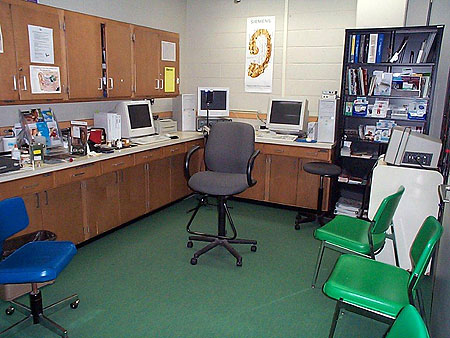
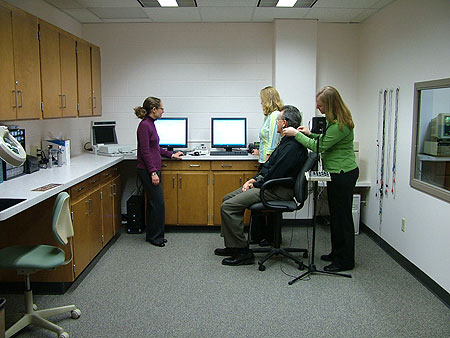
• The plan for this remodeling project was to develop two lab
spaces out of the current lab space. This would require the removal and
recycling of the sound booth, which was not operational and took up a
great deal of the current lab space.
• A wall was built down the middle of the existing room allowing a
second lab to be developed. Remodeling consisted of the following items:
dismantle and recycle the sound booth, repair floor where the sound
booth was, cut in new doorway, construct wall to divide space in half,
carpet entire space, install acoustic 2’x2’ ceilings, install 2’x4’
parabolic fluorescent light fixtures (12), electric wiring, separate
HVAC for each room, construct cabinets with plastic laminate top, and
install sink. Along with the remodeling of the space both labs were
equipped with the same instrumentation.
• Having two Hearing Aid Labs for fitting hearing aids allows
our audiologist to conduct two hearing aid fitting appointments at the
same time.
Before and after photos
|
 |
|---|
Lab Modernization Grant 2008
• Lab Modernization CPS ComD Lab Grant 2008 for $85,441.00 (this
grant was used to update our video system and remodel our clinic.
• The old clinical video system was installed in the Center for
Communicative Disorders in the 1970s. That made it approximately
37-years-old. The system was still functional but over the years the
quality of the video and audio signals significantly degraded because of
the age of this system. The American-Speech-Language-Hearing
Association (ASHA), which is our accrediting body requires that students
have direct supervision during their clinical practicum experiences.
• With the old system supervisors were unable to change the angle of the camera to enhance the image.
• It was difficult for supervisors to watch multiple students during therapy.
• The new system now allows supervisors to change the angle of the
camera, zoom in and out, and make high-quality digital recordings of the
session.
• Session recording can be viewed at a later time by both the supervisor and/or students.
• Supervisors now can watch multiple students from their office computer.
• Parents are now also able to observe using the video system in a separate observation area.
• The overall clinic was redecorated to give it more of a
modern professional look: furniture was reupholstered or purchased, new
carpeting, and re-painted furniture and new carpet, new furniture
throughout clinic rooms.
Old Lobby
Student-Centered Excellence
• Our master’s program in speech-language pathology has steadily grown
to currently admitting 30 students each year. In addition, our number of
applicants continues to increase and 2012 there were 163 applicants for
speech-language pathology and 56 applicants for the collaborative
Wisconsin Au.D. program.
• Graduates from our audiology and speech-language pathology
graduate programs continue to score above the national average on the
PRAXIS exam averaging between 95-100%.
• Our graduates continue to have a 100% employment rate for both audiology and speech-language pathology.
• 2004-05: Maggie Watson became the advisor of UWSP’s student
chapter of the National Speech Language and Hearing Association
(NSSHLA). This is a dynamic and active group of students primarily
made-up of undergraduate students who are involved locally with the
community.
• 2005-06: The UWSP National Student Speech-Language-Hearing
Association (NSSLHA) Chapter wrote and was awarded a matching Community
Service Grant for $1,000 for the Wood County birth-to-three program to
assist in the purchase of assistive technology equipment for this
program.
• 2006-07: The NSSLHA Chapter wrote and was awarded a matching
Community Service Grant for $1,000 for the Wood County birth-to-three
program to assist in the purchase of assistive technology equipment for
this program.
• 2006-07: The UWSP NSSLHA Chapter developed a scholarship for
undergraduate ComD majors. This is the first such scholarship that the
student organization has established.
• 2008: Jayna David, a graduating senior in ComD, made the commencement address at the spring ceremony.
• 2008: The UWSP NSSLHA Chapter wrote and were awarded a matching
Service Grant of $500 from the National NSSLHA Organization. “Operation
Smile” is an international program that provides children from Honduras
with cleft lip and/or palate with surgical and speech-language pathology
services. The money NSSLHA received was used to purchase materials to
assist an SLP who is working with children with cleft lip and/or palate.
• The UWSP Student Academy of Audiologist (SAA) was newly formed on
our campus in fall 2009. This organization is a joint chapter with
students on the UW-Madison campus. The following are the activities
students were involved with throughout the community and region. In
2011, students from the Au.D. program attended the national convention
of American Academy of Audiology (AAA) in Chicago and the Wisconsin
Student Academy of Audiology (SAA) and won second place in a national
student contest.
• 2011: The School of Communicative Disorders held the first Open
House for students accepted into the SLP and Au.D. programs. Students
assisted in this open house and answered any questions from the
perspective of bring a student in the program.
Technology-Enhanced Learning
• Classrooms in our department have the most current technology available for instruction.
• Within our department, students have access to over 16 computers
for report writing, accessing the Internet, and accessing library
resources.
• Students have access to state-of-the-art laboratory technology in
the areas of augmentative and alternative communication, voice and
speech science, audiological testing including pure tone, vestibular,
balance testing, along with hearing aid fitting and analysis.
International Learning Opportunities
• 2005-06: David Henry developed a study abroad course titled: The
International Business of Hearing Aids. He traveled to visit the
different hearing aid manufacturers in Denmark, Switzerland, and
Germany. This course was designed to target Au.D. students from around
the country.
• 2008-09: Pam Terrell traveled to the Integrated Center for the
Treatment of Cleft Lip and Palate in Curitiba Brazil. The purpose of her
trip was to explore the possibility of the School of Communicative
Disorders and the Center in Curitiba Brazil developing an international
study trip for ComD graduate students for May 2010.
• 2010: Pam Terrell took 15 students to Brazil for this
international learning opportunity. All of the students had completed
ComD 786 (Maxillofacial Disorders) so they were knowledgeable regarding
cleft lip and palate, but this experience in Brazil provided them
practical experiences regarding the different surgical procedures, as
well as a different cultural perspective associated with cleft lip and
palate. This was the first time that ComD has provided students with an
international learning experience.
• Pam Terrell and Gary Cumley have been in contact with the
Wisconsin Nicaragua Project and have begun talks in developing another
international learning opportunity for graduate and undergraduate
students to observe and assist SLPs in Nicaragua in providing speech and
language services to individuals.
Scholarships
Established Student Scholarships
• Helen Scheidt Endowment Fund (Outstanding Junior Student)
• John Joanis Endowment Fund (Outstanding Senior Student)
• Communication Disorders Alumni Fund and Communication Disorders Excellence Fund
o Outstanding Speech/Language Pathology Graduate Student
o Outstanding Audiology Graduate Student
o Dean’s Awards- Junior, Senior, Graduate in Audiology, Graduate in Speech Language
• Liz Enos Memorial Award
• Nash Family Communicative Disorders Scholarship
• Johnson Family Speech-Language Pathology School Award
• Tufts Graduate Student Scholarships
• Al and Jan Noel Scholarship
• St. Michael’s Hospital Scholarship
• Donald Aylesworth-Pauline Isaacson Nontraditional Award in Communicative Disorders
• Florence Donermeyer Award
Newly-Developed Student Scholarships
• Cook Chappell Scholarship ($26,000 initial donation)
• Danielle Gorectke Memorial Scholarship ($20,000 initial donation)
• Terri Witt Memorial Scholarship ($20,500 initial donation)
• Avada Audiology and Hearing Care Scholarship ($1,000 annual scholarship)
• Gary Glascoe Memorial Scholarship
• NSSLHA Professional Development Award
Outstanding Communicative Disorders Alumnus
• Jackie Zuelke-Karch (2003-04)
• Nina Cass (2004-05)
• Denise Van Den Heuvel (2005-06)
• Catherine Steffen (2006-07)
• Julieanna Burmesch (2007-08)
• Laurie Schmidt-Charlesworth and Sondra Reynolds (2008-09)
• Holly (Kloiber) Dumproff (2009-10)
• Catherine Conely (2010-11)
 Skip to main content
